
How to keep adult friendships alive: the 4-step Recurring Room Framework.
A structural fix for a structural problem. Reading time: 9 minutes.
There is a person you have been meaning to see for six months.
You like them. They like you. There is no rupture, no falling-out, no quiet grievance neither of you wants to name. You are simply two adults with calendars, and every time one of you proposes a date, the other has a conflict, or the date moves, or the date holds but somebody is exhausted, and the friendship — which would compound beautifully under any reasonable conditions — instead spends another month suspended in scheduling limbo.
This is the central problem of adult friendship in 2026. Not connection. Coordination.
Most adult friendships do not die from rupture. They die from inertia. They die because every single instance of the friendship requires a fresh initiation — someone has to text first, someone has to suggest, someone has to negotiate, someone has to confirm — and the cumulative cognitive cost of running that negotiation makes the friendship slowly more expensive than its current owners are willing to pay.
“Friendships you have to schedule are friendships you will eventually stop scheduling.”
The fix is not to schedule harder. The fix is to schedule once.
That is the entire premise of the Recurring Room Framework — the single highest-leverage tool in the Connection Toolkit, and the one structural move that disproportionately determines whether the rest of your social fitness stack actually compounds.
Why coordination kills friendships.
The infrastructure that historically produced friendship at scale — neighborhood diners, bowling leagues, church basements, recurring civic clubs, the coffee shop where the same regulars showed up at the same time — has been progressively dismantled over six decades. Ray Oldenburg called these “third places.” Robert Putnam documented their collapse in Bowling Alone. The U.S. Surgeon General formalized the public-health consequences in the 2023 advisory on loneliness and isolation.
The substance of that collapse is rarely named correctly. We talk about it as a loneliness epidemic — a feeling problem — and then prescribe individual interventions: meditate more, attend a workshop, download an app, find a therapist. None of those interventions touch the actual mechanism. The actual mechanism is that the architectural conditions that produce friendship as a byproduct of ordinary life — proximity, repeated unplanned interaction, and shared vulnerability — have been replaced with conveniences that eliminate the very encounters those conditions depend on.
When the encounter has to be manufactured every time, the manufacturing cost becomes the limiting factor. Most adults can absorb the cost of manufacturing one friendship date a month. Almost no one can absorb the cost of manufacturing the eight to twelve recurring encounters per friendship per year that the research on friendship maintenance suggests are required to keep the relationship in a state of compounding rather than slow decay.
“You do not have a connection problem. You have a coordination tax problem.”
What a Recurring Room actually is.
A Recurring Room is a structured, repeating social container in which the same people show up at the same place at the same time, on a fixed cadence, for a specific shared activity, with no per-instance coordination required.
Read that definition twice. Every word in it is doing work.
- Same people — Repeat exposure is what produces the cohort intimacy that turns acquaintances into friends. Rotating audiences do not produce friendship; they produce networking.
- Same place — Proximity is the architectural condition Putnam, Oldenburg, and the third-places literature are all pointing at. The room is the room. It does not migrate.
- Same time — Cadence locks the calendar. Once the time is fixed, the time stops being a decision.
- Fixed cadence — Weekly, biweekly, or monthly. Past the threshold of “monthly,” the room is no longer recurring in a meaningful behavioral sense; it has become an occasional event.
- Shared activity — There is something to do. The activity is the alibi for the room — the reason you show up that makes the social investment culturally legible. Without it, attendance becomes a referendum on the friendships, which is exactly the dynamic the recurring room is built to avoid.
- No coordination per instance — This is the keystone. Once the room is set up, attendance is a default behavior. You do not text to confirm. You do not negotiate. You show up.
| WHAT A RECURRING ROOM IS NOT. It is not a one-off event, however good. The dinner party that everyone agrees to do again and then doesn’t is not a recurring room.It is not a group chat. Group chats are coordination surfaces. The recurring room is what the group chat is supposed to produce but rarely does.It is not a friend you see often. Singular relationships are not rooms; they do not generate the cohort dynamics that make the structure load-bearing.It is not networking. The architectural test for whether something is a recurring room is whether you would still attend if your career outcomes did not depend on it. |
The 4-step Recurring Room Framework.
Four steps. In order. Skipping any of them collapses the structure.
Step 01 · Pick a container.
The container is the activity that gives the room its alibi. Running. Cooking. Reading. Sitting at a co-working table on Tuesdays. Practicing pottery on Wednesdays. Doing a 90-minute studio block on Saturday mornings.
Good containers share three traits. They have a clear start and a clear end so attendance is behaviorally bounded. They have a built-in shared focus so conversation does not have to be performed continuously. And they have a low setup cost so the cost of the room is not perceived as the cost of the friendship.
Bad containers fail any of those three. “Let’s hang out” is not a container. “We should grab drinks sometime” is not a container. “Catching up” is not a container. These phrases describe intent without structure, and intent without structure is exactly what the coordination tax metabolizes into nothing.
Step 02 · Lock the cadence.
Pick a recurrence and protect it like a doctor’s appointment. Weekly is the gold standard. Biweekly works if weekly is logistically impossible. Monthly is the floor — past monthly, the room is no longer doing the work.
Put it on the calendar as a recurring event. Send the calendar invite to every attendee. The calendar invite is the operational artifact that converts the room from intention into infrastructure. Until the recurrence is on every participant’s calendar with notification defaults intact, you have not locked the cadence — you have stated an aspiration.
The single most common reason rooms collapse in the first month is failure to formalize the cadence in a shared calendar. The invitation is the structure. Without it, every week is a renegotiation, and the coordination tax returns immediately.
Step 03 · Keep the cohort.
Pick four to eight people. Same people every time. Resist the urge to keep widening the circle.
Four is the minimum because attrition is real. Some weeks two of your people have conflicts; the room still has to function. Eight is the maximum because past eight the room becomes a production rather than a relationship, and the dynamics that produce friendship — repeated exposure to the same specific personalities — start to dilute.
Keeping the cohort means closing the room. You can have guests occasionally. You cannot keep swapping the regulars. The friendship is produced by the cohort, not by the activity; the activity is the alibi. If the cohort keeps changing, the alibi is intact but the friendship infrastructure is not being built.
This is the rule most people’s good instincts will fight. The instinct toward inclusion is ethically sound. The instinct toward inclusion in this specific structural slot is what kills the room. There are other slots in your social life where inclusion belongs. The recurring room is not one of them. The recurring room is where you build depth.
Step 04 · Cross the 8-week threshold.
Most new rooms die between weeks three and seven. This is not a coincidence. It is the predictable inflection point where the novelty of the new ritual fades, the calendar pressure starts to bite, and the cohort’s commitment is tested before the compounding payoff has begun to arrive.
The eight-week threshold is the point past which the room generates more relational return than it costs to attend. Before week eight, the room is an investment. After week eight, the room is a generator. The conversational shorthand has started to form. The in-jokes have started to accumulate. The cohort has begun to know each other well enough that showing up is no longer a small act of social courage; it has become a small act of going home.
The discipline is to attend through the trough. Show up at week four even when it would be easier not to. Show up at week five when the email is sitting unread. Show up at week six when you are tired. The compounding does not start until the threshold is crossed, and the threshold is not crossed by anyone who treats each week’s attendance as an individual decision.
“Before week eight, the room is an investment. After week eight, the room is a generator.”
Five recurring rooms that work.
Five real shapes the structure can take. Pick the one that fits the life you actually have, not the life you would have if you optimized everything else first.
01 · The run club.
Tuesday and Thursday mornings, 6:30 a.m., the same loop, the same coffee after. Four to six people. Pace matched roughly enough that the group runs together. The shared activity is movement; the friendship infrastructure is the coffee. Weekly attendance becomes a default by week four; by week twelve the cohort has shared enough vulnerable conversation at mile three that the room is doing real work.
02 · The supper club.
First Sunday of every month, 7:00 p.m., rotating host. Six to eight people. Whoever hosts cooks the main; the rest of the cohort fills in the table. The container is the meal. The monthly cadence is the maximum-defensible recurrence for a labor-intensive container; weekly is unsustainable, biweekly is hard, monthly is achievable for ten years.
03 · The co-working room.
Wednesday afternoons, 1:00 to 5:00 p.m., the same coffee shop or co-working space, the same table if you can claim one. Four to six people. No agenda — everyone works on their own stuff. The shared activity is parallel-play productivity; the friendship infrastructure is the breaks. This is the lowest-coordination-cost recurring room and the one most people underestimate. It compounds exceptionally well for entrepreneurs, freelancers, and remote workers whose default social environment is empty.
04 · The weekly studio.
Saturday mornings, 9:00 to 10:30 a.m., the same studio class — yoga, pilates, dance, boxing, climbing. Pick the class and commit to the year. The cohort forms organically over time as the same people return week after week and gradually convert from familiar faces into actual relationships. The friendship infrastructure builds in the pre-class lobby and the post-class coffee. This is the lowest-friction entry point for someone whose social graph is currently dormant.
05 · The monthly book club.
Third Wednesday of the month, 7:30 p.m., rotating venue. Five to eight people. One book a month; everyone reads or comes anyway. The container is the book; the friendship infrastructure is the digression. The most durable book clubs spend twenty minutes on the book and two hours on the cohort’s lives, which is exactly correct. The book is the alibi.
The implementation checklist.
Use this to set up a recurring room this week. The order matters; do not skip steps.
- Pick the container — Decide the activity. Be specific enough that the room has a name.
- Pick the cadence — Weekly, biweekly, or monthly. Write down the day and the time.
- Pick the cohort — Four to eight people. Write the names down. Resist adding a ninth.
- Send the invite — A real calendar invitation. Recurring event. Notification defaults on.
- Run weeks 1 through 8 — Treat attendance as non-negotiable. Cross the threshold.
- Re-evaluate at week 12 — Adjust container, cadence, or cohort if needed. Do not abandon the room.
| THE SINGLE SENTENCE TO SEND. Most rooms never start because the setup conversation is too elaborate. Send this instead:“Hey — I’m starting a [container] on [day] at [time], starting [date]. I want the same four or five people every week. Want in?”That sentence does the work. It names the container, locks the cadence, signals the cohort discipline, and asks for a binary commitment. Send it to four people you actually want in the room. Forward the calendar invite the same day. |
The part nobody wants to hear.
The recurring room only works if you stop treating attendance as a weekly decision. The people who succeed with this framework are not the people with the most free time or the most charismatic friend group. They are the people who decided once, eight weeks ago, that Tuesday morning is the run, the supper club is the first Sunday, the book club is the third Wednesday — and then, when the calendar conflict appeared, they moved the calendar conflict.
This is unfashionable. The wellness culture of the last fifteen years has trained us to optimize every choice in real time, to honor our energy, to listen to our bodies, to opt out of obligation when obligation does not align with our current emotional weather. Some of that guidance is healthy. Almost none of it applies here. Friendship infrastructure is built by showing up when you do not feel like it; the cohort’s reliability is the relational asset, and reliability is not built by people who only show up when their nervous system gives them permission.
The recurring room is, in the end, an act of structural commitment to the people in it. That commitment is what produces friendship; the activity, the cadence, the cohort, the threshold are all in service of it. Adults who build durable social fabric understand this intuitively. The framework just makes the operating discipline explicit.
What to do this week.
Pick one of the five containers above. Pick four people. Pick a day and a time. Send the single sentence. Forward the calendar invite. Run weeks one through eight without re-litigating the decision.
By week twelve, the room will be doing more for your social wellness than any individual protocol you could buy. By month six, it will be a permanent feature of your life that produces friendship, vocabulary, in-jokes, repair, and the very specific relief of being known by a small group of people who keep showing up — which is the thing the entire wellness industry has been failing to sell you a substitute for, because no substitute exists.
| COMING NEXT IN THE CONNECTION TOOLKIT. Article 04 · The Eight Friday Texts — a Friday-cadence prompt sequence for keeping your outer-ring relationships alive between recurring-room sessions. Article 05 · The Hug-Test — the in-person diagnostic for whether a recurring room has actually produced friendship, or is still operating in acquaintance mode. Free, sent on Day 14 and Day 19 of the +wellvyl Connection Toolkit newsletter. If you got here from the Day 9 email, both are already on the way. |
Get the free +wellvyl Media Toolkit.
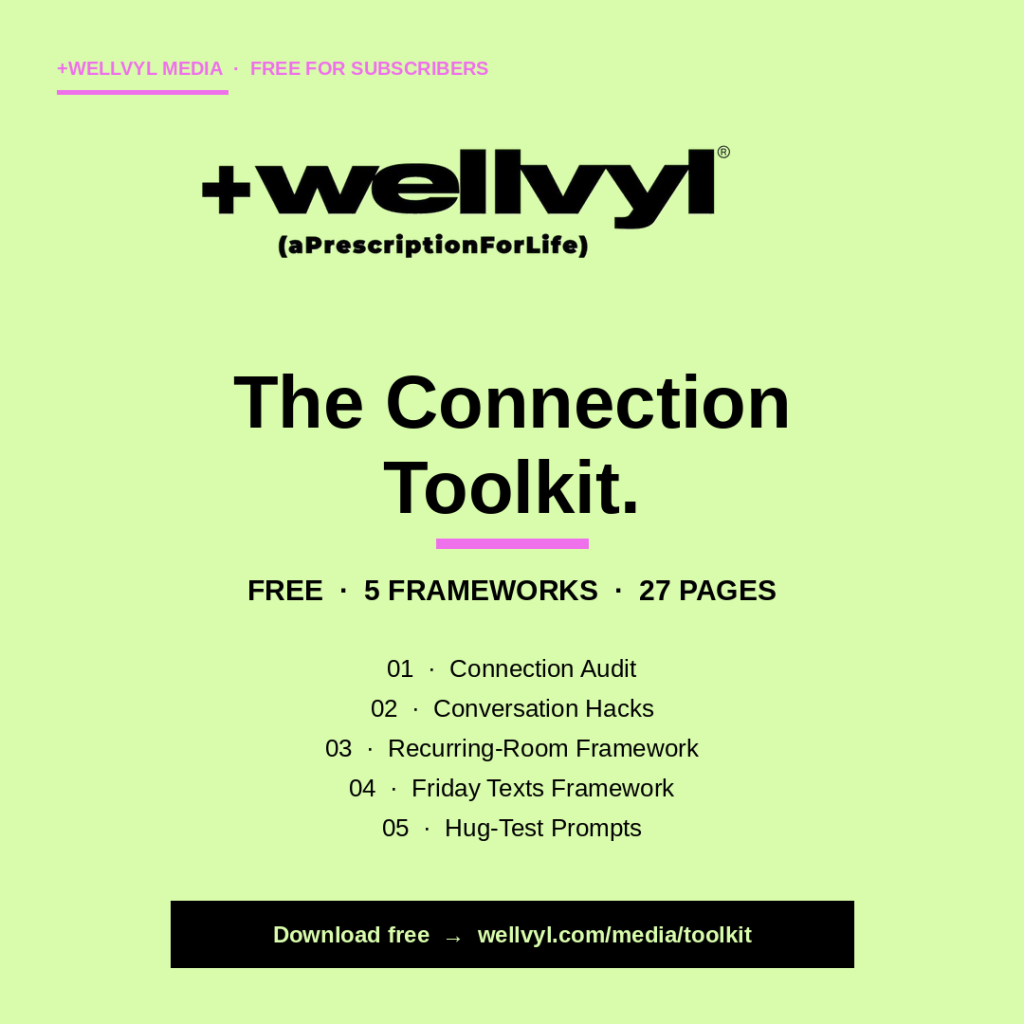
The full Toolkit includes the printable Connection Audit, the Conversation Hacks Vol. 1 reference card, the Recurring-Room Framework, the Friday Texts, and the Hug-Test Prompts. Five frameworks total. Free with email signup. We send three pieces a week on the practice of friendship and social wellness; you can unsubscribe at any time.
About +wellvyl Media.
+wellvyl Media is the editorial channel of WELLVYL PBC, a New York-based social-wellness company. The channel translates credentialed research on belonging, loneliness, and connection into NYC Edge cultural content. Every research claim we publish is attributed to its named, published source, listed in the References on each piece.
Choose a Subscription



Shop +wellvyl APPAREL