How to text an old friend without saying “Sorry it’s been so long.”
Six conversation hacks for restarting cold connections
You know the text. The one you’ve been meaning to send for nine months. The one where it’s been so long that any normal opener now feels embarrassing.
Most people, faced with that thread, start with some version of: “Hey! Sorry it’s been so long. We should really catch up…”
And then send nothing. Because that opener doesn’t work, and on some level we know it.
This is a piece about why “sorry it’s been so long” almost always fails, and six concrete scripts that work instead. Steal any of them. Send today.
The apology trap
When you open a cold thread with an apology, you do three things that hurt the message.
First, you spotlight the silence. The recipient was almost certainly not actively waiting for your text. The apology informs them that you were aware of the silence, felt bad about it, and now want them to validate the apology. That’s an emotional ask before any practical content.
Second, you front-load the friction. The recipient now has to do work — respond to the apology (“no worries!”), reciprocate it (“I should have texted too!”), or acknowledge the gap (“yeah it’s been forever!”). All of which takes more energy than the actual reconnect would.
Third, you signal that the silence was significant. Which makes the next silence significant. Which is the opposite of what you want.
The fix is structural. You don’t address the silence. You skip it. You open with something the recipient can respond to in under five seconds. And you give them an out.
Six hacks for restarting cold conversations
Hack 01 · Skip the apology
The script: “Saw this and thought of you →” + [link / meme / article specifically about them]
You’re not asking for engagement. You’re delivering a small gift. There’s nothing to respond to — they can like it, reply with “lol thanks,” or ignore it without social cost. But you’ve established that you were thinking of them, and you’ve reopened the channel.
The mistake to avoid: don’t send something generic. The link or meme should be about something they specifically care about. A photography meme to a photographer friend. A real-estate article to your friend who just bought a house. A dumb corgi video to your friend who has a corgi. Generic content reads as performance; specific content reads as attention.
Hack 02 · Anchor to a specific date
The script: “Friday 4 pm, [the specific spot]?”
Specific times and places are easier to say yes or no to than vague offers. “We should grab coffee sometime” requires the recipient to do scheduling work. “Friday at 4 at La Cabra?” requires a yes or no. Research on commitment-and-consistency in social psychology suggests that concrete proposals get accepted at significantly higher rates than abstract ones, because the cognitive load of accepting is lower.
The mistake to avoid: don’t include three options (“Friday at 4, or Saturday morning, or maybe sometime next week?”). The whole point is to give them a single yes/no decision, not a scheduling puzzle. Three options is courteous in theory and exhausting in practice.
Hack 03 · Ask one sentence, not three
The script: “What’s the last thing that made you laugh?”
Cold threads die when the reopener is too high-effort to respond to. “How are you? How’s work? How’s [partner]? How’s the apartment?” requires the recipient to compose a multi-paragraph state-of-the-union answer. Most people put it off, then forget, then the thread goes cold again.
A single concrete question with a quick answer is responder-friendly. You’re modeling that the bar for re-engagement is low.
The mistake to avoid: don’t ask “how are you?” That’s actually too open-ended to answer. Ask something specific: “What did you have for breakfast?” “What was the last book you finished?” “Where’d you go on your last trip?” Specific is easier.
Hack 04 · Reference a specific shared thing
The script: “Still thinking about [specific shared moment from when you were last together].”
You’re invoking a real memory, which signals two things — that the time you spent together actually mattered to you, and that there’s a story to pick up. The recipient is invited into a continued conversation rather than a brand-new one.
Dr. Mark Leary’s work on self-presentation theory shows that signals of consistent regard — signals that show you’ve been thinking about someone over time — carry significantly more weight than one-off compliments or check-ins. The reference-to-shared-thing is one of the strongest forms of consistent regard available in a text.
The mistake to avoid: don’t reference something they might have forgotten. If the moment was small (a passing joke, a half-paragraph of a conversation), they may not remember it, and the reference will feel performative. Choose a memory specific enough to be real but big enough to be remembered.
Hack 05 · Volunteer an inconvenient detail
The script: “Quick heads-up — I’m running late / I’m tired / I had a rough week,” + the actual ask.
Pre-emptive vulnerability gives the recipient an entry point that’s bigger than transactional. You’re modeling honesty before they have to ask. This works especially well with friends you genuinely want to deepen the connection with — the kind of friend you’d let see you tired.
It also functions as practical information. If you’re tired, they know to keep it short. If you had a rough week, they know not to lead with “so what’s new!”
The mistake to avoid: don’t perform vulnerability you don’t actually feel. Don’t volunteer something inconvenient that’s actually a flex (“I’m so exhausted from this work trip to Tokyo”). The detail should be real, specific, and small.
Hack 06 · End with a next ask
The script: “Tuesday at 7?” / “Same place next week?” / “Should we make this a monthly thing?”
Most cold-thread reopenings end with “let me know!” which delegates all the work back to the recipient. They have to think of a time, find their availability, and propose it. That work doesn’t happen. The thread dies again.
Closing with an actual proposal converts the reconnect into something specific. The recipient now has to do one piece of work: say yes, or counter-propose. Both are easy.
The mistake to avoid: don’t propose something so specific it feels like a corner (“Tuesday at 7, the back booth at the Italian place on 23rd, I already made a reservation”). The proposal should be specific enough to act on but loose enough to negotiate.
How to use these today
You don’t need all six. You don’t even need three.
Pick one person you’ve been meaning to text. Pick one of the six hacks above. Send it before you finish reading this paragraph.
The thing that makes the reconnect succeed isn’t a perfect script. It’s just sending the message at all. The hacks lower the resistance to sending — that’s their entire job.
Common questions
What if they don’t respond?
Wait three days. Send one follow-up, low-stakes: “Hey, no rush — wanted to make sure that didn’t get lost.” If they still don’t respond, accept that this person isn’t currently available to reconnect, and move on. Their non-response is information, not a verdict on you.
What if it’s been more than a year?
The hacks work the same way at one year, three years, or ten years. The longer the gap, the more important it is to skip the apology and anchor to something specific.
What if I owe them a real apology for something?
That’s a different conversation. Don’t use these hacks. Send a separate, intentional, real apology — and don’t bundle it with a friendly reconnect. The two messages do different work and shouldn’t share a thread.
What if I’m not sure they want to reconnect?
Most adults are open to reconnecting with most past friends. The bigger barrier is logistical, not emotional. The hacks are designed to remove the logistical barrier, not to argue the emotional case. If they don’t want to reconnect, you’ll find out quickly and at low cost.
Is this manipulative?
These are conversation patterns that lower the response cost for the person you’re texting. That’s the opposite of manipulation, which would be patterns that raise the response cost or extract something. The hacks are designed to be friendly to the recipient — they make replying easier, not harder.
What the science says
The conversation patterns above draw on three lines of research:
• Dr. Mark Leary (Duke University) on self-presentation theory — the role of “signals of consistent regard” in friendship maintenance.
• Robert Cialdini on commitment-and-consistency — why concrete proposals get accepted at higher rates than abstract ones.
• Robin Dunbar’s friendship-layer research (Oxford) on the cognitive limits of close relationships and how active maintenance prevents drift.
Each of the above researchers is part of the canonical reading list referenced inside the +wellvyl Media editorial program. Their longform work appears in the Inner Circle tier and in our deep-dive articles.
Get the rest of the Toolkit
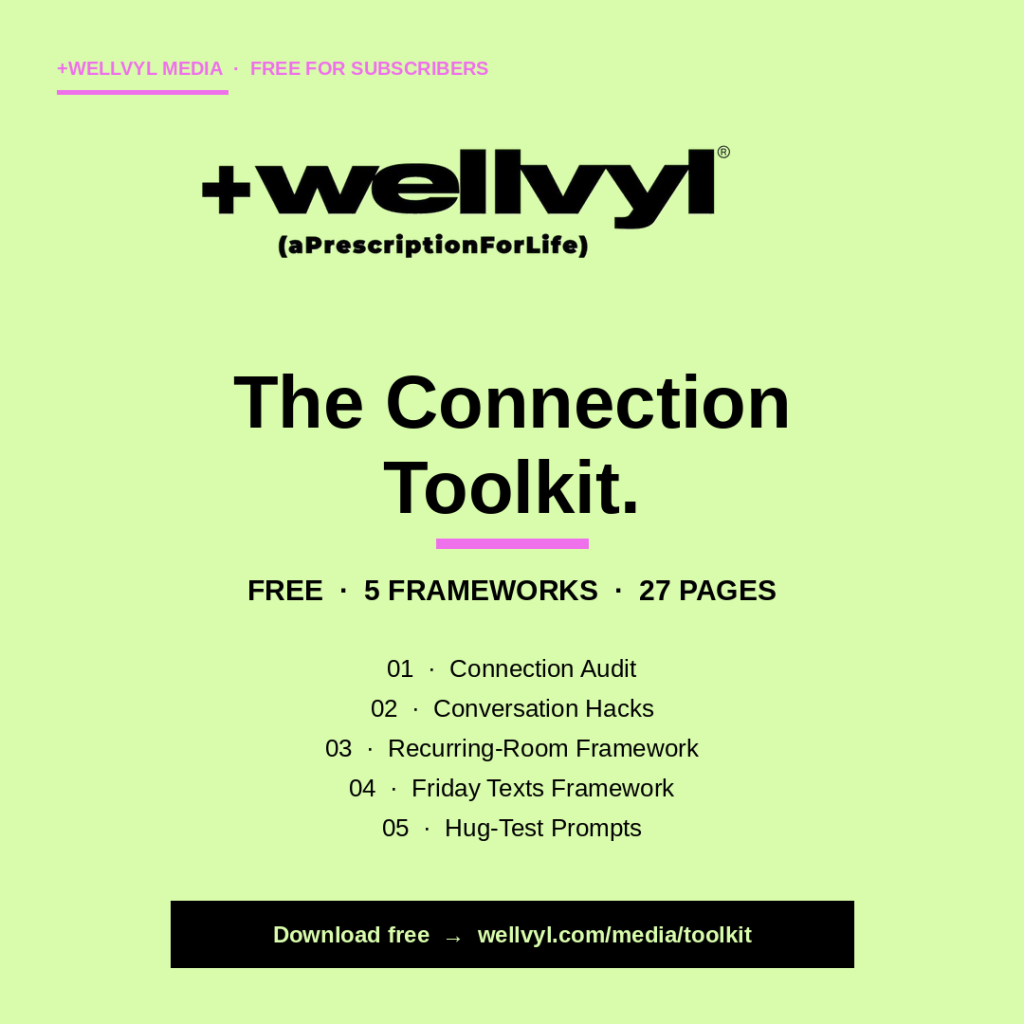
The Six Conversation Hacks are one of five tools in the +wellvyl Media Connection Toolkit — the free five-tool collection for restarting the connections you’ve already got.
The other four:
• The 7-Question Connection Audit — a five-minute diagnostic of your current connection load.
• The Recurring-Room Framework — the four-step protocol behind every durable friendship.
• Eight Friday Texts — three-line scripts that actually get sent.
• The Hug-Test — five prompts plus a 30-day plan for co-regulation contact.
Get the full Toolkit at wellvyl.com/media/toolkit
About +wellvyl Media.
+wellvyl Media is the editorial channel of WELLVYL PBC, a New York-based social-wellness company. The channel translates credentialed research on belonging, loneliness, and connection into NYC Edge cultural content. Every research claim we publish is attributed to its named, published source, listed in the References on each piece.
Choose a Subscription



Shop +wellvyl APPAREL