How to keep the outer ring alive: the Eight Friday Texts.
A ten-minute weekly protocol. Reading time: 7 minutes.
The Recurring Room solves the inner-circle problem. It does not solve the outer-ring problem.
Your inner circle is the four to eight people you see on a recurring cadence in the room you built last week. Your outer ring is everyone else who matters — the friend who moved to LA, the college roommate who has two kids and a company, the colleague-turned-friend you used to walk to lunch with, the cousin you actually like, the person you spent a transformative year with in your twenties and have not seen for eighteen months. These are not strangers. They are the second concentric ring of your social life, and they are quietly dissolving while you focus on whatever this week is.
The outer ring does not need a recurring room. The outer ring needs a maintenance protocol. The maintenance protocol is the Eight Friday Texts.
“Your inner circle keeps the room. Your outer ring needs a protocol. Friday is the protocol.”
Why Friday.
Pick a day. Any day. The exact day matters less than the fact that there is one. We pick Friday for three structural reasons.
- Friday has built-in social latency — People are wrapping the work week and tilting toward connection. A Friday text lands in a different psychological register than a Monday text. Replies come faster. Reciprocation is higher. The whole exchange runs on a softer surface.
- Friday closes the loop — Whatever you send on Friday can convert into a weekend plan, a Sunday voice note, a Monday update. The reply window is open before the work week reopens and crushes it.
- Friday is the only day adults remember — Tuesday is forgettable. Wednesday is forgettable. Friday is the cultural pin. If you build your protocol around a forgettable day, you will forget to run the protocol.
If Friday is genuinely impossible for your schedule, pick a different day and commit to it. The point is that one day every week is the day. The texts go out on that day. Always. No exceptions for being busy — ten minutes is the entire protocol; if you cannot find ten minutes on a recurring day, the friendships are not what is at issue.
What the Eight Friday Texts are not.
Before the scripts: the protocol fails when it gets confused with three adjacent activities. Name them up front.
| WHAT THIS IS NOT. It is not networking. You are not maintaining the relationship because you might need them later. You are maintaining the relationship because you actually like them. If the test “would I send this text if there were zero career upside” fails, this is not the right person for the protocol. It is not catching up. “We need to catch up” is the dead text. It implies a future obligation rather than an actual present action. Catching up is what happens after you have already restarted the thread. It is not performance. The friend does not need to be impressed. The friend needs to be remembered. Long, polished, self-aware texts are harder to reply to than short, specific, genuinely-curious ones. |
The Eight Friday Texts.
Eight specific scripts. Use one each Friday for eight Fridays, then cycle through them again. You do not need to send all eight to the same person; you need to send one text to one person every Friday. The cycle is for the operator (you), not the recipient.
01 · The Memory Hit.
Send a specific memory the friend would not expect you to still hold. Not a general fond-feelings note. A piece of evidence that they are still in your head.
Sample: “Was just thinking about the time we got lost in Berlin and the waiter drew us that map on the back of the receipt. I still have the receipt.”
Why it works: Specificity is the signal. “Missing you!” could be sent to anyone. “The Berlin receipt” could only be sent to one person. Specificity is proof of attention.
02 · The Specific Question.
Pick a topic they would expect you to remember and ask one direct, answerable question. Not three. One.
Sample: “How did the conversation with your mom end up going? You said you were dreading it.”
Why it works: A single specific question has a clear reply path. Three questions produce paralysis. The cost of replying must be lower than the social cost of not replying, or the thread dies.
03 · The Recommend.
Send a book, a show, a restaurant, an article, a song — something you encountered this week that made you think of them specifically.
Sample: “This book is doing a thing I think you would love. I will not say more. Trust me.”
Why it works: Recommendations are a low-friction gift. They require no response other than “thanks, will check it out” — but they generate a follow-up thread when the friend actually reads/watches/listens.
04 · The Photo.
Send one photo. No commentary, or one sentence maximum. Photos are an underused friendship-maintenance instrument because adults overthink them.
Sample: “[Photo of a sunset, a meal, a sign, your dog being absurd] — “This felt like a you thing.””
Why it works: Photos register as low-stakes intimacy. You let the friend into a specific moment of your day without requiring a response.
05 · The Voice Note.
Send a 60-to-90-second voice note. Replaces 200 words of typing. The voice carries warmth that text cannot, and asks less of the recipient than a phone call.
Sample: “Hey — voice note because typing this would take forever. Three things I wanted to tell you about…”
Why it works: Asynchronous voice is the single highest-bandwidth friendship-maintenance channel that has emerged in the last decade. Most adults underuse it because they overthink the recording. Send it on the first take.
06 · The Article Toss.
Send an article with a single sentence framing why you sent it. The sentence is the friendship signal; the article is the alibi.
Sample: “Read this and immediately wanted your take. Specifically the section about the third decade thing.”
Why it works: Article-tossing makes the friend feel like an intellectual peer rather than a recipient of small talk. It opens an actual conversation, not a social transaction.
07 · The Quick Plan.
Propose a specific, low-commitment plan with a real date. Not “sometime soon.” A date.
Sample: “Coffee in two Sundays at the place on 9th? Or a walk in the park if it is sunny. Either one. You pick.”
Why it works: Two-option proposals are easier to accept than open-ended ones. A concrete date two weeks out is socially achievable in a way that “we should grab something soon” never resolves into an actual meeting.
08 · The Just-Because.
Send a text with no agenda and no question. Just a statement of presence. This is the hardest one to write and the most valuable.
Sample: “No reason for this text. Just wanted you to know I think about you more than I send evidence of it.”
Why it works: The just-because is the highest signal in the protocol because it asks for nothing. The friend cannot misread it as a setup for an ask. It is the closest text-message equivalent to an unprompted hug.
Four rules for running the protocol.
The protocol is simple. Most failures are operational. Four rules cover ninety percent of them.
- Set the alarm — Friday at 11 a.m. is the suggested window. Late enough that the day has settled in; early enough that the reply window is still wide. Calendar reminder, recurring weekly.
- Pick the person Thursday night — Decide before Friday morning who the text is going to. If you decide who Friday morning, you will spend the ten minutes deciding and never send anything.
- Send the text — Do not edit it five times. Do not check yourself out of it. If it reads true to you on the first pass, send it. The friend will not analyze the punctuation.
- Do not chase — If they reply, great. If they do not reply, fine. The text is the practice; the reply is the bonus. Do not text a second time the same Friday looking for the response.
| THE SINGLE RULE UNDER THE FOUR RULES. Send the text. Always. Every Friday. Most friendship-maintenance failures are not failures of intent. They are failures of operating discipline. The Eight Friday Texts protocol exists because the friendships you are running it for cannot survive your good intentions; they can only survive your consistent operating behavior. Run the protocol weekly. Adjust everything else around it. |
Pairing with the Recurring Room.
If you have built a recurring room (see Article 03), the Eight Friday Texts are the protocol that handles everyone the room is not for.
Run together, the two systems are sufficient for a robust adult social fabric. The recurring room gives you four to eight people you see every week at depth. The Eight Friday Texts gives you a maintained outer ring of fifteen to forty people you stay actively connected to without weekly attendance. Inside that two-ring architecture, the third ring — acquaintances, professional contacts, friendly strangers — takes care of itself through ordinary life.
What you do not need: a third system. The wellness industry will keep selling you protocols, apps, retreats, journals, communities, and “connection platforms” promising to fix this for you. Two structural moves and ten minutes on Friday are sufficient. The structure is sufficient. The structure is the answer.
What to do this Friday.
Pick one person tonight. Pick one of the eight scripts. Set an alarm for 11 a.m. Friday. When the alarm goes off, send the text. Repeat next Friday. Repeat for eight weeks. Then keep going.
By the eighth Friday, the outer ring will start replying differently. By the twentieth Friday, the protocol will be a permanent feature of your life. By the fifty-second Friday, you will have run the friendship-maintenance protocol fifty-two times and your outer ring will be in better shape than the outer rings of any of your peers who are still relying on intention.
| COMING NEXT IN THE CONNECTION TOOLKIT. Article 05 · The Hug-Test — the in-person diagnostic for whether a recurring room has actually produced friendship, or is still operating in acquaintance mode. Five prompts you can run at the end of any in-person session. Free, sent on Day 19 of the +wellvyl Connection Toolkit email automation. If you got here from the Day 14 email, the final article is already on the way. |
Get the free +wellvyl Media Toolkit.
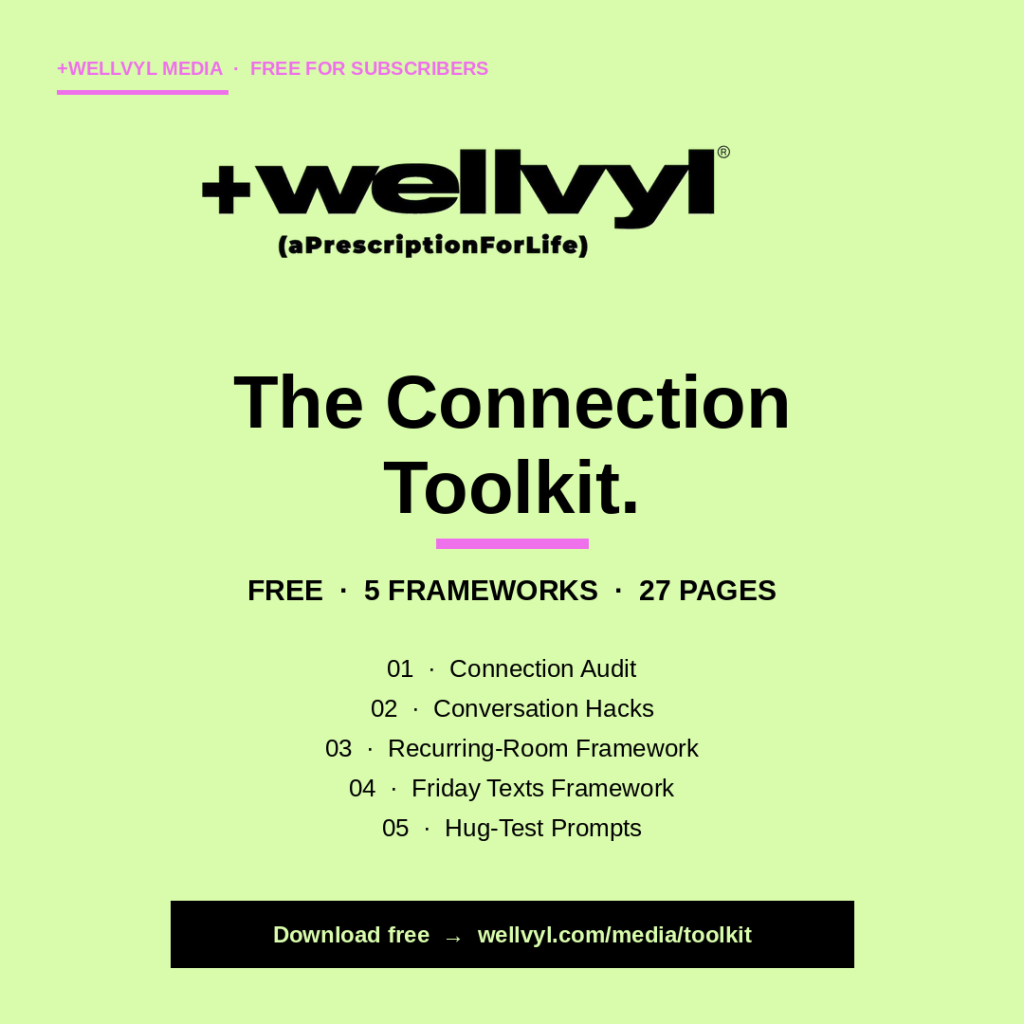
The full Toolkit includes the printable Connection Audit, the Conversation Hacks Vol.1 reference card, the Recurring-Room Framework, the Friday Texts Framework, and the Hug-Test Prompts. Five frameworks total. Free with email signup. We send three pieces a week on the practice of friendship and social wellness; you can unsubscribe at any time.
About +wellvyl Media.
+wellvyl Media is the editorial channel of WELLVYL PBC, a New York-based social-wellness company. The channel translates credentialed research on belonging, loneliness, and connection into NYC Edge cultural content. Every research claim we publish is attributed to its named, published source, listed in the References on each piece.
Choose a Subscription



Shop +wellvyl APPAREL