The Connection Audit: A 7-Question Self-Assessment for Measuring Your Social Wellness
TL;DR  ·  THE 50-WORD ANSWER
The Connection Audit is a free 7-question self-assessment that measures whether your social life is structurally healthy. It takes four minutes. You answer yes or no on seven questions covering voice contact, photographic evidence, emergency support, friction in friendships, recurring rituals, physical touch, and in-person voice exposure. Score five or higher indicates rare social fitness. Based on research from Julianne Holt-Lunstad (Brigham Young University), Mark Leary (Duke University), and the U.S. Surgeon General's 2023 advisory on loneliness.
What is the Connection Audit?
The Connection Audit is a 7-question self-assessment that diagnoses the structural health of your social life. Each question targets one specific environmental signal — voice contact, photographic evidence of in-person time, who you’d reach for in crisis, the friction in your closest friendships, the presence of recurring rituals, physical touch in the last week, and in-person voice exposure. The audit takes about four minutes. There is no app, no account, and no data collection. You answer yes or no, count your yeses, and read the score band.
Unlike clinical loneliness scales such as the UCLA Loneliness Scale (Russell, 1996), the Connection Audit measures observable social architecture rather than internal emotional states. Both matter. But internal feelings are downstream of external structure. Fix the architecture and the feelings change.
Why measuring social wellness matters.
Modern wellness culture is exhaustively instrumented around individual physiology. You can measure your VO2 max, your resting heart rate, your heart-rate variability, your sleep score, your macros, your steps, your hydration, and your time-restricted eating window. You cannot, apparently, measure whether your social life is healthy. This is the largest blind spot in the contemporary wellness category.
The evidence on social health is unambiguous. A 2010 meta-analysis by Dr. Julianne Holt-Lunstad and colleagues at Brigham Young University, covering 148 studies and more than 300,000 participants, found that strong social relationships were associated with a 50% increased likelihood of survival across the study period. The effect size was comparable to, and in some comparisons larger than, the effects of smoking cessation, physical activity, and obesity prevention (Holt-Lunstad, Smith, & Layton, 2010, PLOS Medicine).
In 2023, U.S. Surgeon General Dr. Vivek Murthy issued a formal advisory titled ‘Our Epidemic of Loneliness and Isolation‘ (U.S. Department of Health and Human Services, 2023). The advisory documented that chronic loneliness is associated with a 26% increased risk of premature mortality, a 32% increased risk of stroke, and a 29% increased risk of heart disease — magnitudes comparable to the mortality risk of smoking up to 15 cigarettes per day.
None of these findings has been integrated into mainstream wellness tracking. Apple Health does not track friendships. Whoop does not score relationships. Oura does not measure whether you had dinner with another person this week. The instrumentation gap is structural. Social health resists quantification because the mechanism — co-regulated nervous-system contact in shared physical space, over time — does not fit cleanly into a product category designed around individual biometrics.
The Connection Audit closes that gap with the lowest-overhead instrument available: a yes-or-no checklist you can run in four minutes on the back of an envelope.
The 7 questions of the Connection Audit.
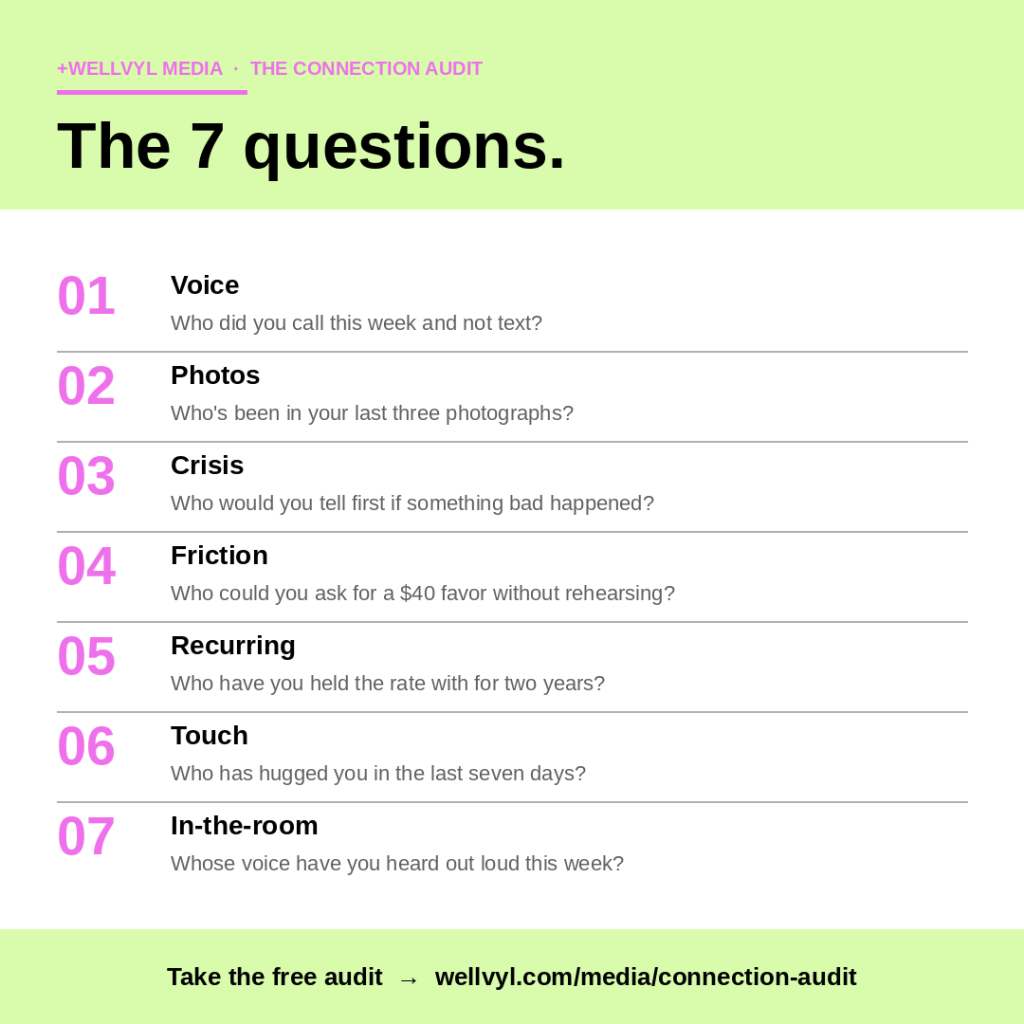
The seven questions are below. Answer each yes or no. Count your yeses. Score yourself in the section that follows. Honest answers only — gaming the audit makes the audit useless.
Question 1 — Who did you call this week, but not text?
Voice contact and text contact are different events. Voice creates co-regulation, the nervous-system phenomenon in which two humans dynamically regulate each other’s physiological state through tone, prosody, and respiratory rhythm (Porges, 2011). Text does not. A five-minute phone call registers in the nervous system as social contact. A 30-message text thread does not. If you cannot name a single person whose voice reached your ear this week — outside of a podcast, outside of a screen, outside of a transactional meeting — score this question no.
Question 2 — Who has been in your last three photographs?
Open your camera roll. Look at the most recent three photographs. Are there people in them — specifically, people who are not strangers at restaurants, not strangers at solo events, and not just immediate family? Photographs are passive evidence of physical proximity. They record where you were and who you were near. If your last three photographs are food, sunsets, and a transit receipt, you have inadvertently documented a week of structural solitude. Score yes only if real, named people appear.
Question 3 — Who would you tell first if something genuinely bad happened today?
This question asks who you would reach for, not who you should reach for. Name them. If the answer is your therapist, your friendship architecture has a structural gap. Therapy is necessary, and this audit is not anti-therapy in any sense. But therapy is a 50-minute weekly appointment that substitutes for what used to be a constant ambient social environment. The person you’d reach for in the first hour after a bad thing happens is the load-bearing person in your social architecture. If you can name them, score yes.
Question 4 — Who could you ask for a $40 favor without rehearsing the ask?
Healthy friendships have low activation energy. A $40 favor — a ride to the airport, picking you up from a medical appointment, covering dinner when you forgot your wallet — is a ten-second ask in a friendship that is functioning. In a friendship that has drifted, the same ask requires twenty minutes of pre-text editing and three rewrites. Name the people you could ask without rehearsing. Score yes if you can name three or more.
Question 5 — Who have you held the rate with for 2+ years, same time, same place, same standing?
This is the recurring-room test. Standing weekly meetings, monthly book clubs, regular Tuesday dinners, run clubs that meet whether or not the weather cooperates. Friendships that compound are friendships with architectural recurrence — they live inside environments that do not require coordination every time they happen. Anthropologist Dr. Robin Dunbar‘s research on social-group dynamics (Dunbar, 1992) and decades of work on third-place theory by sociologist Dr. Ray Oldenburg (Oldenburg, 1989) both converge on the same finding: durable adult friendships require structural environments, not just emotional intent. If you have at least one such standing date held for two years or more, score yes.
Question 6 — Who has hugged you in the last seven days?
Touch is among the most underrated metrics in the wellness catalog. Dr. Tiffany Field‘s three decades of research at the Touch Research Institute (University of Miami School of Medicine) document the role of safe interpersonal touch in nervous-system regulation, immune function, and depression risk. A hug is the lowest-overhead way to receive it. The seven-day window matters because the physiological effects of touch are short-lived and require regular replenishment. If you cannot name a single person — romantic partner, family member, friend — who has hugged you in the last seven days, score no.
Question 7 — Whose voice have you heard, out loud, in the room — not on a podcast, not on a screen — this week?
This is the in-the-room test. Phone calls do not count. Video calls do not count. Podcasts do not count. Even highly engaged screen-mediated conversation lacks the proximity, mirrored breath, and air-shared acoustic environment that the human nervous system reads as “another human is present.” Roommates and family members count automatically. The diagnostically interesting number is everyone else. If you can name two or more non-cohabiting people whose actual voices reached your ear in actual proximity this week, score yes.
How to score the Connection Audit.
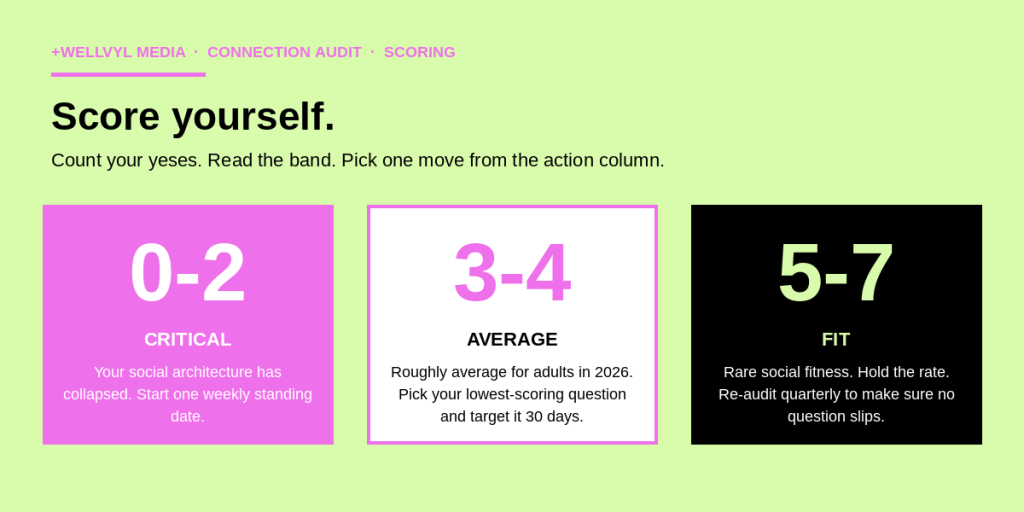
Add up your yeses. The scoring bands are below.
| 0–2 YESES · SOCIAL ARCHITECTURE HAS COLLAPSED This is not a personality issue. It is a missing-environment issue. The fix is structural, not emotional.Install one weekly standing commitment: same time, same place, same person. Two months of consistent attendance and your score will move materially. Start with the Recurring-Room Framework inside the +wellvyl Media Toolkit (link at the end of this post). |
| 3–4 YESES · ROUGHLY AVERAGE You are not in social crisis, but you are not compounding either. Most people scoring in this band are running their friendships on coordination fuel, which depletes faster than they realize.Pick the single question you scored lowest on. Aim a 30-day intervention at it. Re-audit at the end of the month. |
| 5–7 YESES · RARE SOCIAL FITNESS You are operating with social architecture that most adults in modern urban environments do not have. The intervention is preservation: do not let any of the seven scores degrade.Most people in your social network are scoring below 4 and would benefit from running the audit themselves. Share this post with one person whose score you’d like to know. |
What to do after the audit.
Run the audit once. Run it again in 30 days. Run it on the people you love when they will let you. The score will move. The variables in the audit are not personality traits — they are environmental observations, and environment responds to attention.
If you scored 0–2 and want a step-by-step protocol for installing your first weekly standing commitment, the Recurring-Room Framework inside the +wellvyl Media Toolkit walks through it.
If you scored 3–4 and your friendship architecture is intact but your conversation cadence has drifted, the Conversation Hacks Vol. 1 inside the same Toolkit gives you six lift-and-paste scripts for restarting dormant threads.
If you scored 5–7 and want to systematize the architecture you already have, the Friday Texts Framework gives you a three-line template and eight tested scripts for compounding the friendships that are already working.
The full +wellvyl Media Toolkit is free with the email signup at the end of this post.
The research behind the Connection Audit.
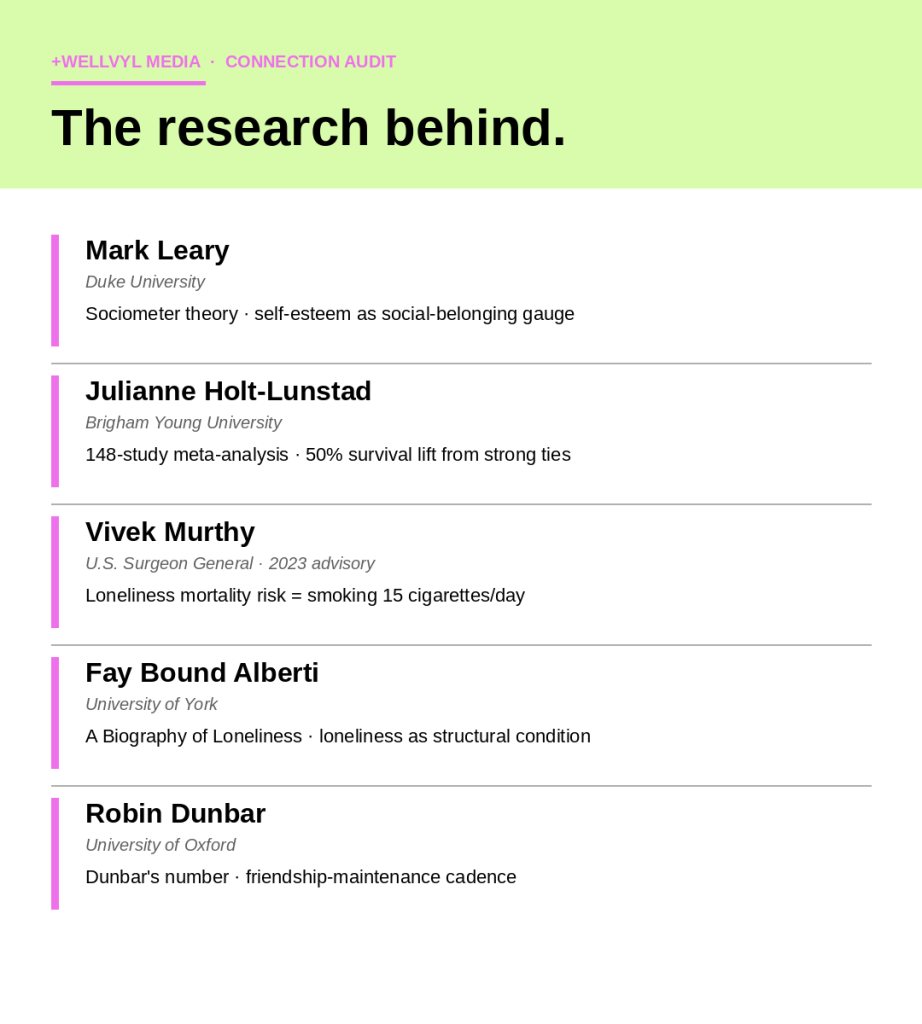
The Connection Audit is structured around the convergent findings of five research programs:
- Sociometer theory (Dr. Mark Leary, Duke University). Self-esteem functions as an internal gauge of perceived social acceptance. The biology of belonging is the mechanism the audit is measuring at the structural level.
- Loneliness as mortality risk (Dr. Julianne Holt-Lunstad, Brigham Young University). The 2010 meta-analysis in PLOS Medicine and subsequent work established the magnitude of social-relationship effects on physical health — comparable to smoking, obesity, and physical inactivity.
- The U.S. Surgeon General’s advisory on loneliness (Dr. Vivek Murthy, 2023). The federal public-health framing of loneliness as an epidemic with quantified mortality risk.
- A Biography of Loneliness (Dr. Fay Bound Alberti, University of York). The cultural-history vantage on how “loneliness” became a recognized modern phenomenon, and why it is a structural condition more than a private failing.
- Third-place theory (Dr. Ray Oldenburg, 1989) and social-group dynamics (Dr. Robin Dunbar). The architectural backbone of recurring-room logic — durable adult friendships require structural environments, not just emotional intent.
Frequently asked questions about the Connection Audit.
Below are ten questions the +wellvyl Media editorial team most often receives about the Connection Audit.
What is a connection audit?
A connection audit is a structured self-assessment that measures the architecture of someone’s social life — voice contact, in-person presence, emergency support availability, friendship friction, recurring rituals, physical touch, and in-the-room voice exposure. The +wellvyl Connection Audit is a free 7-question version that takes four minutes.
How long does the Connection Audit take?
About four minutes for a first run. Subsequent re-audits typically take two minutes or less because the answers are usually obvious in retrospect.
Is the Connection Audit a clinical diagnostic?
No. The Connection Audit is a self-administered structural check, not a clinical screening instrument. It is not a substitute for the UCLA Loneliness Scale, the De Jong Gierveld Loneliness Scale, or any clinically validated instrument. If you score 0–2 and are concerned about your mental health, speak with a licensed clinician.
Can I run the Connection Audit on someone else?
The audit is designed for self-administration. You can share it with a friend and discuss results together, but answering on someone else’s behalf will not produce accurate scoring.
What is a good Connection Audit score?
Five or more yeses indicates rare social fitness in contemporary adult environments. Three to four is roughly average. Two or fewer indicates social architecture that needs rebuilding.
How often should I run the Connection Audit?
Once at baseline, then every 30 days if you scored 3 or below, and every 90 days if you scored 4 or above.
Where did the Connection Audit come from?
+wellvyl Media designed the audit by synthesizing the consensus research of Mark Leary, Julianne Holt-Lunstad, the U.S. Surgeon General’s 2023 advisory, Fay Bound Alberti‘s cultural-history work, Ray Oldenburg‘s third-place theory, and Robin Dunbar‘s social-group findings into a single yes-or-no instrument that anyone can self-administer in four minutes.
Is loneliness really as harmful as smoking?
The U.S. Surgeon General’s 2023 advisory documented that the mortality risk associated with chronic loneliness is comparable to the mortality risk associated with smoking up to 15 cigarettes per day, based on the underlying epidemiological research, including the 2010 Holt-Lunstad meta-analysis in PLOS Medicine.
What is the difference between social wellness and mental wellness?
Mental wellness measures internal emotional and psychological functioning. Social wellness measures the structural conditions of someone’s social environment — frequency of contact, depth of relationships, recurring rituals, and physical proximity to other humans. The two are correlated but distinct; social wellness is typically upstream of mental wellness.
Where can I download the free Connection Audit PDF?
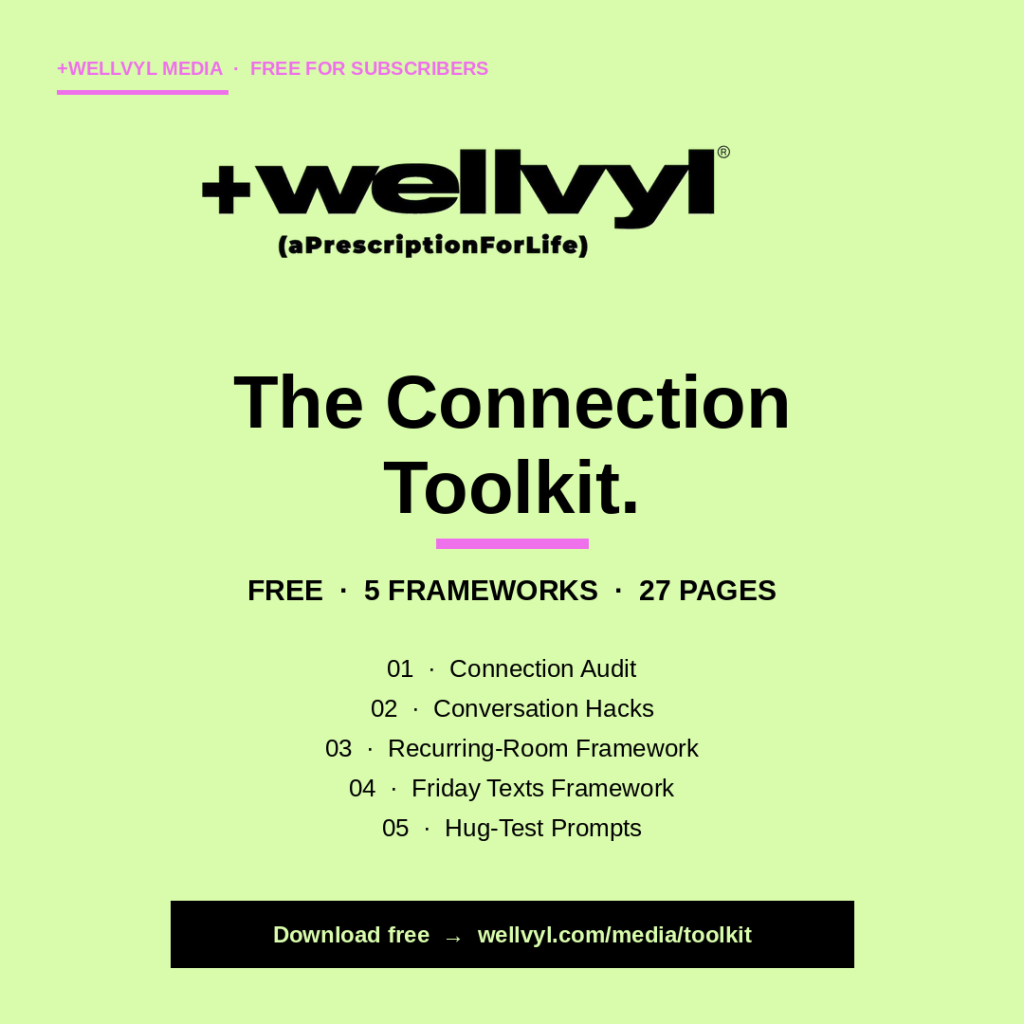
The free printable Connection Audit, plus the full +wellvyl Media Toolkit (Conversation Hacks Vol. 1, the Recurring-Room Framework, the Friday Texts Framework, and the Hug-Test Prompts), is available with email signup at wellvyl.com/media. There is no paywall.
Get the free +wellvyl Media Toolkit.
The full Toolkit includes the printable Connection Audit, the Conversation Hacks Vol. 1 reference card, the Recurring-Room Framework, the Friday Texts Framework, and the Hug-Test Prompts. Five frameworks total. Free with email signup. We send three pieces a week on the practice of friendship and social wellness; you can unsubscribe at any time.
About +wellvyl Media.
+wellvyl Media is the editorial channel of WELLVYL PBC, a New York-based social-wellness company. The channel translates credentialed research on belonging, loneliness, and connection into NYC Edge cultural content. Every research claim we publish is attributed to its named, published source, listed in the References on each piece.
References.
Dunbar, R. I. M. (1992). Neocortex size as a constraint on group size in primates. Journal of Human Evolution, 22(6), 469-493.
Holt-Lunstad, J., Smith, T. B., & Layton, J. B. (2010). Social relationships and mortality risk: A meta-analytic review. PLOS Medicine, 7(7), e1000316.
Leary, M. R., & Baumeister, R. F. (2000). The nature and function of self-esteem: Sociometer theory. Advances in Experimental Social Psychology, 32, 1-62.
Office of the U.S. Surgeon General. (2023). Our Epidemic of Loneliness and Isolation: The U.S. Surgeon General’s Advisory on the Healing Effects of Social Connection and Community. U.S. Department of Health and Human Services.
Oldenburg, R. (1989). The Great Good Place: Cafes, Coffee Shops, Bookstores, Bars, Hair Salons, and Other Hangouts at the Heart of a Community. Marlowe & Company.
Porges, S. W. (2011). The Polyvagal Theory: Neurophysiological Foundations of Emotions, Attachment, Communication, and Self-Regulation. W. W. Norton.
Bound Alberti, F. (2019). A Biography of Loneliness: The History of an Emotion. Oxford University Press.
Choose a Subscription



Shop +wellvyl APPAREL