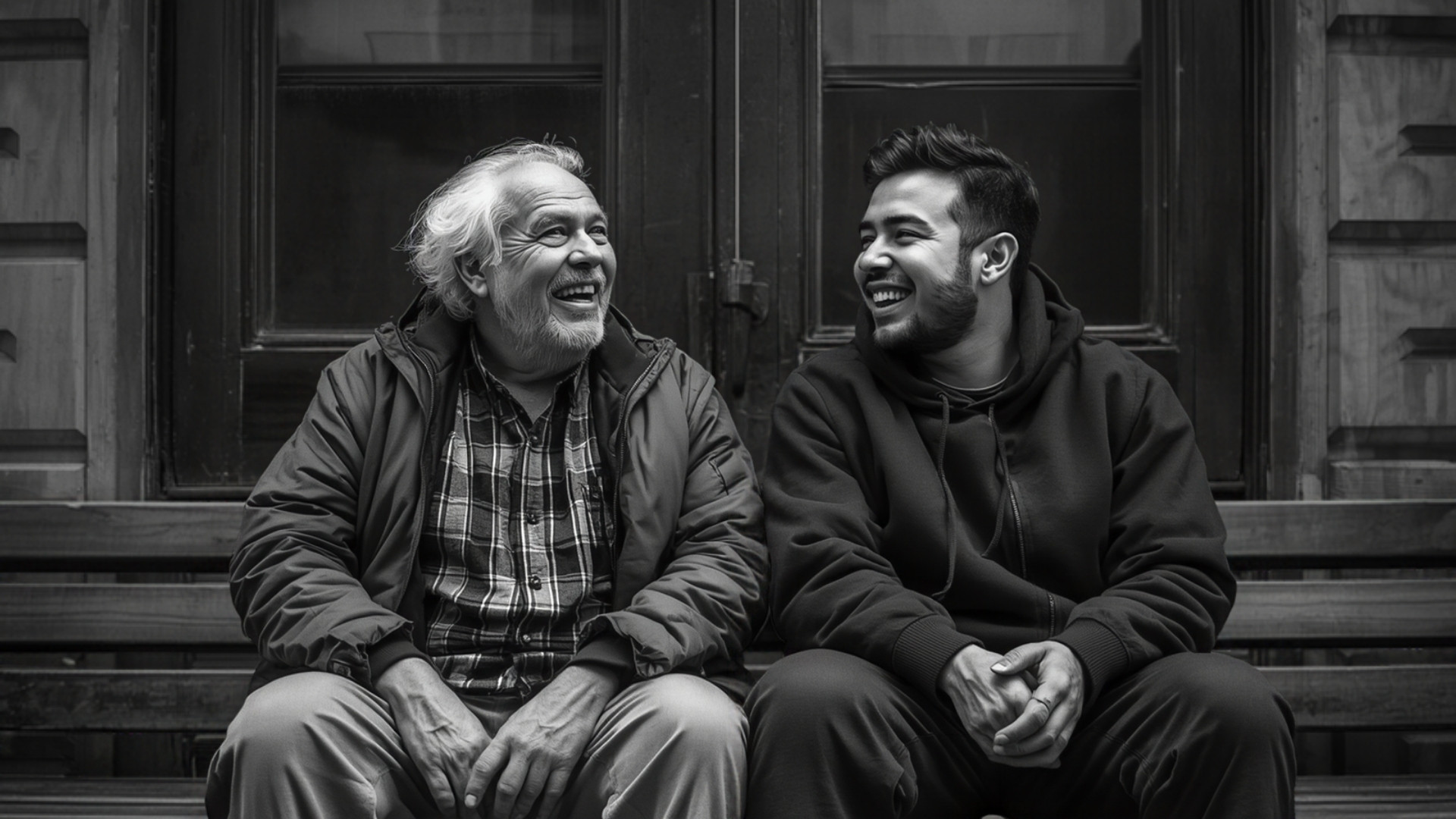
Everyone You Know Is Your Age
Try something. Think of the ten people outside your family you talked to most this month. Now guess how old each one is.
For most adults the spread is narrow, usually within ten years either way and often closer. Our friends, our coworkers, the people in our group chats and the strangers in our feeds are mostly people born around when we were. We don’t notice, because it’s always been like that. But it hasn’t always been like that, and nobody chose it.
Look at how a life gets sorted. School groups children by birth year, which is how we’re taught what a peer is: someone your exact age. College is four cohorts deep. The first job puts you on a team of other people starting out. Then housing sorts by life stage: neighborhoods full of young renters, suburbs full of families with young kids, and eventually communities built for people over 55. Even our feeds learn our age and serve us people like us. By forty, most of us spend almost no unstructured time with anyone twenty-five years older or younger who isn’t a relative.
In 2005 the sociologists Gunhild Hagestad and Peter Uhlenberg named this the social separation of old and young. They argued it’s institutional: it’s built into how we organize schooling, work and housing, not into anyone’s preferences. They also argued it’s a root of ageism. When you never spend time with people at the other end of life, they turn into a category instead of people.
What we lose is easy to underrate, because you don’t miss a relationship you never had.
The young lose perspective. Not advice, which is cheap and everywhere, but the presence of someone who has already lived through the thing you’re dreading. Someone whose career ended, whose marriage nearly broke, who buried a parent, and is still standing. The gerontologist Karl Pillemer spent years interviewing older Americans for his Legacy Project, and in 30 Lessons for Living one regret came up again and again: how much of their lives they’d spent worrying about things that never happened. You can read that in a book. It lands differently from someone across a table who means it.
The old lose the future. Laura Carstensen’s research at Stanford shows that as people sense their time getting shorter, they deliberately narrow their circles toward a few emotionally close relationships. That’s wise, and it’s one reason older adults often report better day-to-day mood than the young. But a circle made only of peers ages with you. Each loss takes a piece out of it that nobody is coming up behind to fill. A network that’s all the same age is a network with an expiration date.
And the middle loses both. People in midlife are surrounded by the very young and the very old, as parents and as adult children, but almost always in a role. Giving care or being responsible isn’t friendship. The relationships across generations that we do have tend to run in one direction.
None of this has to be this way, and the fixes are less exotic than they sound. In Deventer, in the Netherlands, a retirement home called Humanitas lets university students live there rent-free in exchange for spending time with the residents as neighbors. They aren’t caregivers or volunteers on a shift, just people in the next room who come to dinner and watch the match. Marc Freedman, in How to Live Forever, makes the larger case: the growing older population is a huge, underused source of the attention young people are starving for, and the young are just as much a source of purpose for the old. Each has what the other is missing.
You don’t need a program to start. You need rooms that aren’t sorted by age:
Join something that mixes ages by default. Choirs, community gardens, running clubs, congregations, rec leagues and volunteer crews. Wherever the thing you do together matters more than your life stage.
If you’re younger, ask an older person a real question. Not “how are you”, but “what did you get wrong at my age?” Then listen past the first answer.
If you’re older, stay in rooms with young people. Not to mentor, which can be another way of keeping a distance, but to be a regular.
If you run a room, refuse to sort it. The easiest way to fill a room is to market it to one demographic. That’s also the easiest way to make sure everyone in it already sees the world the same way.
The wellness industry sorts us by age as a matter of course: the app for Gen Z, the program for over-50s, the retreat for midlife women. That’s good marketing. It might be bad medicine. Some of the connection we’re missing isn’t about how many people we know. It’s that they’re all about as old as we are.
Next time you’re in a room, look around and count the decades. If there’s only one or two, that’s worth noticing. It’s also one of the easier things in your life to change.