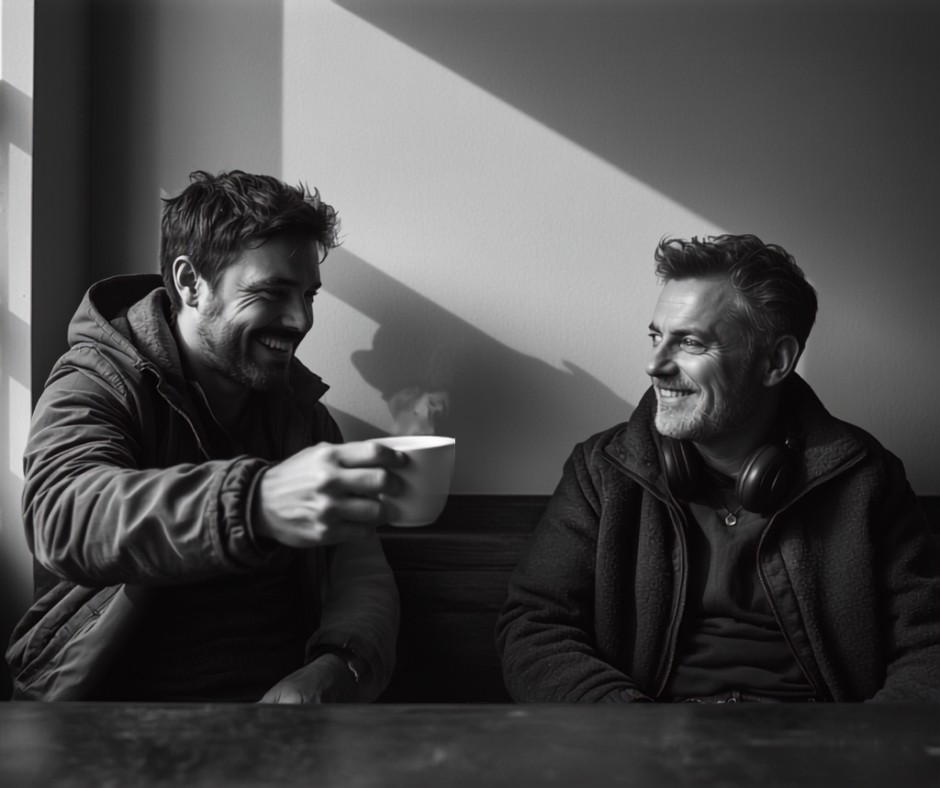
The People You Almost Know
The people you almost know are doing more for you than you think.
Not your best friend. Not your partner. The barista who starts your order when you walk in. The guy at the gym whose name you are ninety percent sure is Dave. The neighbor two doors down you talk to about nothing for four minutes. The regular at the bar who nods. These are your weak ties, and the research on them is one of the most underrated findings in social science: they are not filler around your real relationships. They are a substantial part of what makes a life feel populated.
Sociologists have known this since the seventies, when Mark Granovetter showed that weak ties do disproportionate work — they were how people actually found jobs, information, opportunities, because your close friends know what you know while your acquaintances know what you don’t. But the part that matters more for how a day feels is simpler and more recent. Studies on brief, casual social contact find that these small exchanges reliably lift mood and sense of belonging, often more than people predict, and that we consistently underestimate how good they will feel before we have them. We think the small talk will be awkward. It almost never is.
Here is why that matters right now. When people say they are lonely, they usually describe a shortage of close friends — the two-in-the-morning kind. So the advice they get is aimed there: go deeper, be vulnerable, invest in your inner circle. But close friendship is expensive. It takes years, and you can only carry a handful. Meanwhile the layer that collapsed most quietly, and that would be cheapest to rebuild, is the outer one — the dozens of low-stakes recurring faces that used to be the ambient social texture of an ordinary week.
That layer is what disappeared first, and it disappeared without anyone grieving it, because no one has a funeral for the acquaintance they stopped bumping into. Self-checkout removed the cashier. Delivery removed the counter. Remote work removed the elevator, the kitchen, the walk to the train. Headphones and phones removed the incidental conversation from every remaining shared space. Each individual removal was a convenience, and I would not undo most of them. But the cumulative effect is that a person can now move through an entire day — a productive, comfortable, well-optimized day — and exchange words with no one who recognizes them.
And the strange part is that we defend it. Nobody wants the small talk in the abstract. We treat these interactions as friction to be engineered away, and we are very good at engineering. But the friction was the texture. A day without a single familiar face is efficient in exactly the way a room with no furniture is spacious.
The fix here is unusually cheap, which is what makes it worth saying plainly. You do not have to make new best friends to feel less alone. You have to become a regular somewhere, and then be slightly less efficient than you could be. Go to the same place at the same time. Take the headphones out for the ninety seconds of the transaction. Learn one name and use it. Ask the follow-up question you would normally skip because you are in a hurry. None of this requires vulnerability, or a personality change, or an app.
Do that for a few weeks in the same handful of places and something quiet happens: the neighborhood starts to recognize you. You are not building a friendship. You are rebuilding the outer ring, and the outer ring is what makes a place feel like yours. It is also, not incidentally, where most close friendships start — nobody becomes your close friend without first being someone you kept running into.
So if the deep-friendship project feels too big right now, start at the other end. Collect the people you almost know. Go back often enough that they almost know you too. That is not a consolation prize for real connection. For most people, most days, it is the thing that was actually missing.